Monday, July 13, 2009

MY GREAT-GRANDFATHER WAS A CRIMINAL


Some people might say something like this. But, generally, they don't do it. However, according to an article of the Daily Telegraph of Sidney, Australia, not only many genealogies have criminals in their stories; even the ex-Prime Minister, John Howard, who finished his period in 2007, has some criminal ancestors in his own. His father Lyall Howard's maternal great-great-grandfather William Tooley was convicted of complicity in the theft of a tortoiseshell watch and transported for life on the ship Fanny in 1816. This is not surprising: between 1788 and 1868, being still Australia a British colony, more than 150,000 convicts were transported to Australia to accomplish with their sentences. In 1851 gold mines were discovered in Australia, and then they stop to send convicts to the country. Why the convicts should be rewarded working on gold mines? Society of Australian Genealogists executive officer Heather Garnsey said many family tree enthusiasts were keen to find a link to a convict when researching their backgrounds. It's important to mention that those "crimes" at that age, could be our "misdemeanors" today, like to steal a piece of bread, to cut a tree, or to steal poultry from a farm. But certainly also were, amongst them, real criminals and murders. Mrs. Garnsey tells us that years before, australian society used to reject to talk about this past. But around 1980 "it became a badge of honor". Now the families take the approach with very good sense of humour: they use to say that, for them, the convict period it's the equivalent of royalty. It wouldn't be a bad idea if we dare to reward with a badge of honor, and all our affection, to all this people who can show publicly their hidden and embarrasing ancestors. Genealogy is in permanent transformation and evolution, and should become a modern, efficient, proactive, and... thrilling discipline.

GENEALOGY: A NEW MODEL OF INTERNATIONAL COOPERATION

(Or How to Play the Prisoner's Dilemma)

That the genealogy is actually in fashion, there's no doubt. But what is really interesting about this fashion, is that, from the beginning of its revival as a popular hobby, it was manifested as a remarkable example, an authentic model of universal cooperation. Cooperation is one of the most important engines of the evolution. Why? For a simple reason: everybody wins. To enlighten this matter we can appeal to a known theoretical problem: The Prisoner's Dilemma. Originally framed in 1950 by Merrill Flood and Melvin Drescher, years later William Tucker formalized the game with prison sentence payoffs. In the generalized form, is a card's game with a banker and two players, with only two cards each: "cooperate" and "defect". Each player puts one card face-down in front of the banker. At the end of the turn, the banker turns over both cards and give them the payments according to these rules: 1) If both players cooperate, they will be rewarded with $ 300.- each. 2) If one player defects and the other one cooperates, the first one is rewarded with $ 500.- and the one who cooperated receives the sucker's payoff of a $ 100.- punishment. 3) If both players defect, they receive the punishment of $ 10.- each for mutual defection, which is not a benefit for anybody. Then, the question is: how would you play? If you evaluate that your opponent plays "cooperate", your best option is "defect", of course (you will gain $ 500.-). But if you think that the other player plays "defect", your best option is not "cooperate", (you may loose $ 100.-) but "defect", indeed. As you see, always the best option is "defect". No doubt. Then, both players evaluate both possible outcomes, and they play "defect" each. And they loose $ 10.- each. Magically, the best option was transformed in the worst one for everybody. In the next hand, you know that your opponet already played "defect", and you cannot run the risk of being punished with $ 100.- if you cooperate. In the case that you had played "cooperate" in the former hand, then, you'll play "defect" now by retaliation. As the other player thinks in the same way, because he won a good prize, or he cannot run the risk either, the same outcome than before is repeatedly played back again. Only if both players understand that the best option is "cooperate" for both of them, and they initially play that way, they will gain $ 300.- dollars always in every turn. This dilemma was applied to all the human interaction and to all the living beings in general. In biology, ethology, politics, economy, sociology, sports, etc. And to all the relations between biologic structures. And, as we are biologic structures, we unconsciously follow this game. Take a look at the world in which we live, and tell me if it's not this way. An experiment based in this dilemma (Tversky, Amos, at the MIT, 2004), showed, as an evidence, that as too much, only the 40% of the players choice the mutual cooperation. You can make a mind game trying to apply the dilemma to whatever you want: it always matches in every interaction in the real life.
It's obvious that genealogy, with its aspect of international cooperation, is a step forward in human evolution. It doesn't mean that we don't have to pay for what is valuated in money, of course. But this wonderful genealogist's world should be considered with more attention by all the social institutions. It evolved faster than others, and with firm steps. Just, exactly, because of its characteristical smart universal cooperation.

Saturday, July 11, 2009

TO DESTRUCTURATE AND TO REINTEGRATE

Any observation, inevitably tends to fragmentation. For example, when we observe a moment in the time of our ancestors, we separate it from everything else. We separate and focus it to look at it well. All our education is based in separating the matters, without relating them.
But nobody bothers about to connect random facts. And this leads to the dispersion of what naturally is related, and to the disinterest of the learners, and to their attention not motivated about the chain of events.
Teachers speak about the French Revolution, but they don't relate to the influence that the work of a writer as Michel de Montaigne, 200 years before, could have had on the approach of humanity which allowed to address toward this process.
My proposal is a new vision of genealogical facts: that every identification in the time will be shaped by an integration of all the related events: historical, philosophical, literary, political and even geographical. My proposal is to destructurate the whole educational program that we have melt in our brains, just to build another one, where no thread could remain unplugged. Only this way we will be able to accede in a conscious way to a coherent interpretation of the facts.
If somebody takes a look to the post on the right, called " The Renaissance ", it will be seen that on there the explanation of the historical moment integrates absolutely everything. Even the "style" of explanation blends the literarature with the history. Is not a coincidence that I've opted for the Renaissance to do this, -probably it happened unconsciously-, so those men of that epoch were not fragmentators; they dominated several sciences simultaneously, as Leonardo Da Vinci , and they were relating them suitably, which was allowing them to advance intensively upon each one of the topics.
The proposal, then, is: to return to the pluralized approach: to return to look at the world as a consequence of everything. It's true that this specialization that we have today is due to the difficulty of to include all the matters in the same storage, because of the scientific advance that we have had. But in our case, we do not need to be experts in detail about everything: we are historical interpreters of families, and with a few basic notions, - the more complete they could be, is of course, better-, well integrated, we will be moving along like fishes in the ocean.
That's precisely the objective of this blog; to discover an understandable vision of all what is around us; towards the integration of the universal thought in a simple event, as the freedom or not of marrying without paternal assent that our forbears used to have. Hopefully we could take the right way, and the genealogy will turn into something much more transcendental.

Friday, July 10, 2009

ARE WE HAPPIER THAN OUR ANCESTORS?


Are we today happier, more satisfied, than all these ancestors that we classify, we study, we record in a tree, and we try to understand? How might we compare the feelings of that people of the previous centuries against our current people? Have we learned to be, in the 21st century, happier than them?
(Click in the photo to see whole note)

IMPUDIQUE ATAVISM

“This it is the line from which I descend ", was commented by a friend of mine, to me, days ago. She referred to an Irish prince of the 14th Century. And she satisfied her ego thinking that she was descending from nobility houses. Again I returned to think that the identity is a fiction, a simple myth constructed by our imagination. There is persistence in the construction of genealogical trees about to show honorable families, abnegates, and promoters of real epic migratory deeds.
And, what if everything was the opposite? What would be changed? If someone descends from the Marquis of Sade, does he or she be labeled necessarily as a potential perverse? And what if the honorable Irish prince would have been more perverse and voluptuous than the same Marquis of Sade? I descend from nobles with dominions, from captains of corsair ships and from notaries of the Navy of France. But who can guarantee about the moral virtues of the lordly nobles and, inversely, why the corsair captains, despite their violent and adventurous connotation, cannot have been excellent persons, generous and solidarious with their peers? And finally, are not we the sons of our own works, without considering the moral quality of our ancestors? If I descend from the Genghis Khan, have I to go out riding a horse and with a sword in my hand to behead people along a central street, jumping over the traffic? If our genealogical search is sincere, and we look for identities, we must find real entities. Without shame, without fears. Every moral even that that the society does not share, is immersed inside the human condition. The real discovery is to find our ancestors, such as they have been, human fallible beings, with their authentic biographical dimension. There might have been misery and selfishness in a wealthy noble, and a poetical song to the life into the dreams of a poor farmer from a hamlet in the middle of the mountains. Let's not use to the genealogy to arbitrarily construct our own character: let's the life to speak by itself, in our case and in that of our ancestors. We cannot modify them already - except by the way of subjective interpretation-, but we still are in this dynamic relations’ process in which our honesty can play in favor on having done the difference between a mediocre and conventional exhibition and a good water-color of excellent quality.

MATHEMATICS AND GENEALOGY


In this planet, we, the human beings are more related of what we think. A mathematical explanation of this affirmation will take us to understand it, though the numbers initially could be a little deceitful.
We all necessarily have 2 parents. And 4 grandparents. And 8 great-grandfathers. And 16 great-great-grand-fathers. If we follow up to the sixth generation, we descend from 32 persons. In the seventh one, of 64. In the eighth one, of 128. In the ninth one, of 256. In the tenth one, of 512. In the eleventh one, of 1024. In the twelfth one, of 2048. And so on, until we find (oh!) in this exponential progression that in the generation N º 18 we descend from 131.072 persons. Hitherto, everything is possible. But if we continue forward, in the generation n º 32 - only 800 years ago – we should descend from 2 billion persons. And here the question comes: how can this be possible if, in the year 1200, there were no these inhabitants in the world, but only approximately 350 millions?
Steve Olson, author of “Mapping Human History ", together with Douglas Rhode, a neurobiologist of the MIT, and computer scientist, developed in 2004 interesting results on this question.
The response is a necessary consequence: in order that this has to happen (and it does) the ancestors have to repeat themselves between generations. For example: the same ancestor may be our forefather on the part of mother in the generation 32 and on the part of father in 31, etc. A simple equation illuminates these figures: 2 billions divided 350 millions, is 5.714. This means that, 800 years ago, our ancestors are repeated in our genealogical trees more than 5.000 times. If to 6 billion today inhabitants the ancestors repeat themselves 5.700 times, it is highly possible that 800 years ago almost we all have common ancestors. If we continue backward in the time, and there are less and less available people to put in the family trees and more branches of 6500 million family trees of the people living today, it’s mathematically inevitable that in some point, will be someone who appears at least once in everybody’s tree. And continuing backward, there will come a time in which every person of the Earth is an ancestor of all of us, until, certainly, someone is the common ancestor of everyone.
In this calculation will be necessary to deduce those who died without leaving descent, and the lines of interrupted lineage.
Inversely, any person that, 800 years ago has emigrated from a continent to other one might be the ancestor of more than 2 billion individuals, nowadays.
Surprising, isn’t it?
Therefore, because of this, it’s necessary to have some care about the ideas on different races, ethnics and the prejudices that all of that transports: all the human beings are more siblings of what we believe!
. “No matter the languages we speak or the color of our skin, we share ancestors who planted rice on the banks of the Yangtze, who first domesticated horses on the steppes of the Ukraine, who hunted giant sloths in the forests of North and South America, and who labored to build the Great Pyramid of Gizeh,” says Steve Olson in an article of Nature.

NEWS ON OUR WEBSITE: HOW WE COULD FIND AN AUNT WHO NOBODY EVER KNEW:


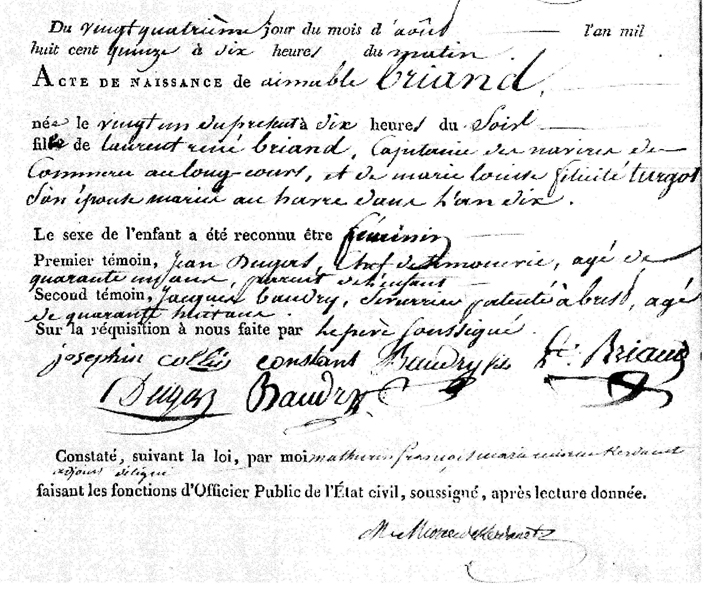
And suddenly, something mysterious happened: somebody appeared - or she reappeared - in our family: Aimable Briand, our aunt-great-great-grand-mother, born in Brest in 1815.
My father used to tell me that my great-grandparents were cousins. But I never found an evidence of this, having checked their certificates of birth and of marriage. When one day, I pay attention to a detail in the marriage certificate of my great-great-grand-father Ange Briand: one of the witnesses, says the document, is “beau frère du contractant " (brother-in-law of the contractor); his name was Philippe Dierce. To be a brother-in-law of my great-great-grand-father, still single, he had to be, necessarily, married with Ange’s sister. But ... who was that sister? On the other hand, the bride’s mother, Eugénie Marie Marchal, had "Dierce" as her surname. Then: Philippe Dierce, being cousin of someone, has to be the cousin of the bride and also a nephew of the bride’s mother. And, searching, I found that, exactly, his father Georges Louis Dierce, was a brother of Victoire Dierce, the mother of my great-great-grand-mother Eugénie. Definitively, Ange married the cousin of his brother-in-law, not his cousin. Only remained to confirm if it was true that my great-great-grand-father Ange had a sister married with Philippe Dierce.
In an old report of payment of royal indemnifications, I found receiving a pension from the colonists expelled from Saint Pierre et Miquelon, who? : Well, precisely Madame Aimable Briand, "veuve Dierce " (widow of Dierce), born in Brest in 1815. From there to obtaining her birth certificate in Brest there was one only more step. Not only have I obtained her birth, but also that of Phillipe Dierce, his husband, and their marriage certificate.
It was a strange sensation: this aunt had got lost between the centuries, had faded away in the night of the time, into the emptiness. And in a moment, probably extemporal, I take her of her hand and give her the welcome to our family back again. Come in, aunt; we were waiting for you.

YOUR GENES CAN REVEAL YOUR SURNAME


Leicester's University has been specialized about genetic studies; in 1984 Professor Sir Alec Jeffreys invented the revolutionary technique of the genetic "fingerprint". Now, the Dr. Turi Kin, using a database of more than 40 thousand individuals, made a Doctoral Research on 2.500 individuals carrying 500 different British surnames. The conclusion is that there are higher probabilities of that those who carry the same surname are genetically tied. She was exploring on a base of Y chromosomes, which are transmitted by paternal line. The idea is that if father’s surname is also passed from father to son, in agnatic succession, there should be a relation between surname and chromosomes Y. The less common a surname is, the more chances has to find this link: surnames like Attenborough or Swindlehurst have 70 % of probabilities. The applications of this study also might help to criminal investigations. The genes might reveal possible surnames of the culprits. Certainly adoptions, false paternities and names-changes can alter this information.
(Source: University of Leicester – News – Press releases).
 
Creative Commons License
Blog Gen Briand by Pablo Briand is licensed under a Creative Commons Attribution-Noncommercial-No Derivative Works 3.0 United States License.
Based on a work at www.genbriand.com.ar.